“`html
contents
- 1、Start with the one question that clears up most confusion
- 2、Virgin wood pulp, pure wood pulp, and virgin pulp, what these labels usually mean
- 3、Why these labels matter in daily life
- 4、Comfort and performance, what changes with different fibers
- 5、Hygiene and safety, what consumers rarely see
- 6、Sustainability, a comparison that stays honest
- 7、Bleaching and “chemical free” claims, what to watch
- 8、How to choose, a simple decision guide
- 9、What OEM and private label buyers should ask for
Labels like virgin wood pulp, pure wood pulp, virgin pulp, and recycled can look similar on a pack.
They often get used as if they mean the same thing, but they point to different questions.
This guide helps you read those words in a practical way.
You will learn what each term usually means, what it does not guarantee, and how to choose for comfort, hygiene, and sustainability.
1、Start with the one question that clears up most confusion
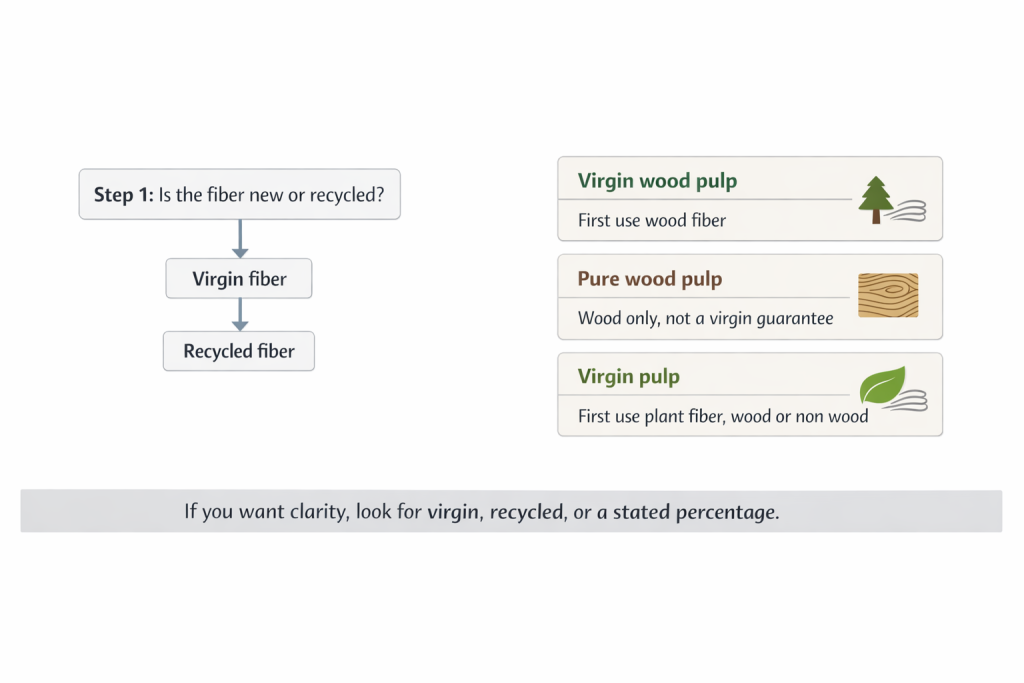
When you see a pulp claim, ask this first.
Is the fiber new, or has it already been used and recycled.
Everything else is detail.
Important detail, but still secondary.
2、Virgin wood pulp, pure wood pulp, and virgin pulp, what these labels usually mean
What “virgin wood pulp” usually means
Virgin wood pulp typically means first use wood fiber.
The fiber comes from wood and has not been through consumer use and repulping.
What you usually get from virgin wood pulp tissue
- more consistent softness from batch to batch
- better strength, especially when wet
- more predictable converting quality, embossing, rewinding, fewer weak spots
What it does not automatically mean
- it does not automatically mean chemical free
- it does not automatically mean fragrance free or dye free
- it does not automatically mean more sustainable than recycled
If you want to treat it as a quality and hygiene signal, it can be helpful.
If you want to treat it as an environmental claim, you need proof.
What “pure wood pulp” usually means
Pure wood pulp usually signals that the sheet is made from wood fiber, not bamboo, bagasse, or other non wood fibers.
It often suggests a wood-only blend.
The problem is that pure wood pulp does not always tell you whether the fiber is virgin or recycled.
In many markets, wood-only tissue can still contain recycled wood fiber and still be described as wood pulp.
A safer way to read “pure wood pulp”
- good for identifying wood-based feel and performance expectations
- not reliable for telling you whether the fiber is first use
- not reliable for telling you the hygiene and contamination risk level
If your goal is clarity, you need one more line on the label.
Virgin, recycled, or a stated recycled content percentage.
What “virgin pulp” can mean, and why it confuses people
Virgin pulp often means first use plant fiber.
It can include wood pulp, but it can also include non wood fibers, like bamboo, wheat straw, bagasse, or mixed plant blends.
That is why “virgin pulp” is not the same as “virgin wood pulp”.
Virgin refers to first use fiber, wood refers to the fiber source.
A practical way to read it
- virgin pulp tells you the fiber is first use
- it does not tell you whether it is wood or non wood
- performance depends on the specific fiber type and the process
3、Why these labels matter in daily life
Toilet paper is a small choice repeated every day.
Small differences in strength, softness, and dispersibility show up quickly.
Labels also affect health decisions for families.
They affect purchasing rules for schools, offices, hotels, and healthcare sites.
The best approach is to match the label to your real goal
- comfort and skin feel
- hygiene and consistency
- environmental footprint and responsible sourcing
- cost per use, not just cost per roll
4、Comfort and performance, what changes with different fibers
Fiber quality matters, but it is not the only driver.
Two products with the same pulp label can feel very different.
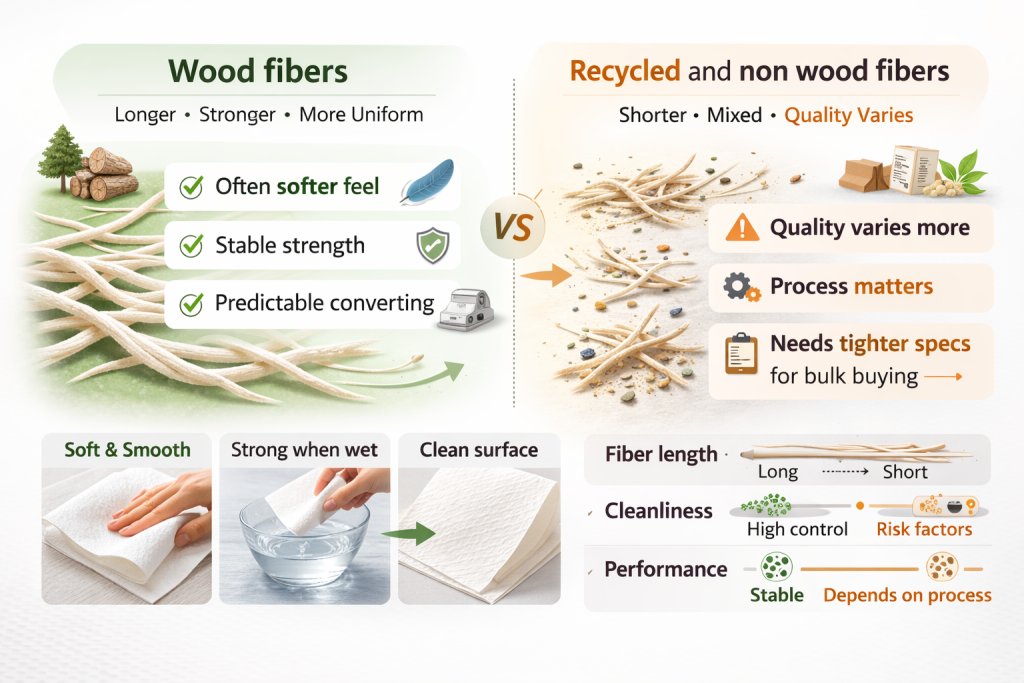
Why virgin wood pulp often feels softer
Virgin wood pulp tends to have longer, stronger fibers.
That helps create a sheet that feels smooth and holds together with less effort.
It also makes product performance more predictable.
That is why many premium lines lean on virgin wood pulp.
Why recycled paper can feel different
Recycled fibers are typically shorter due to repeated processing cycles.
Shorter fibers can reduce softness and strength, and can increase dust or lint in low quality grades.
Modern technology has improved recycled tissue a lot.
Still, quality varies more, and procurement needs tighter specifications.
Why non wood virgin pulp can feel firmer
Bamboo, bagasse, and wheat straw can be positioned as eco-forward options.
Many people notice a firmer feel, especially in lower basis weight or less refined grades.
Some blends close the gap.
You cannot assume all bamboo or all bagasse tissue will feel the same.
5、Hygiene and safety, what consumers rarely see
People often assume recycled paper is automatically safe.
Often it is, but the risk profile is different.
Recycled production depends on the cleanliness of the waste stream.
It also depends on how well a mill manages contamination, de-inking, and microbiological control.
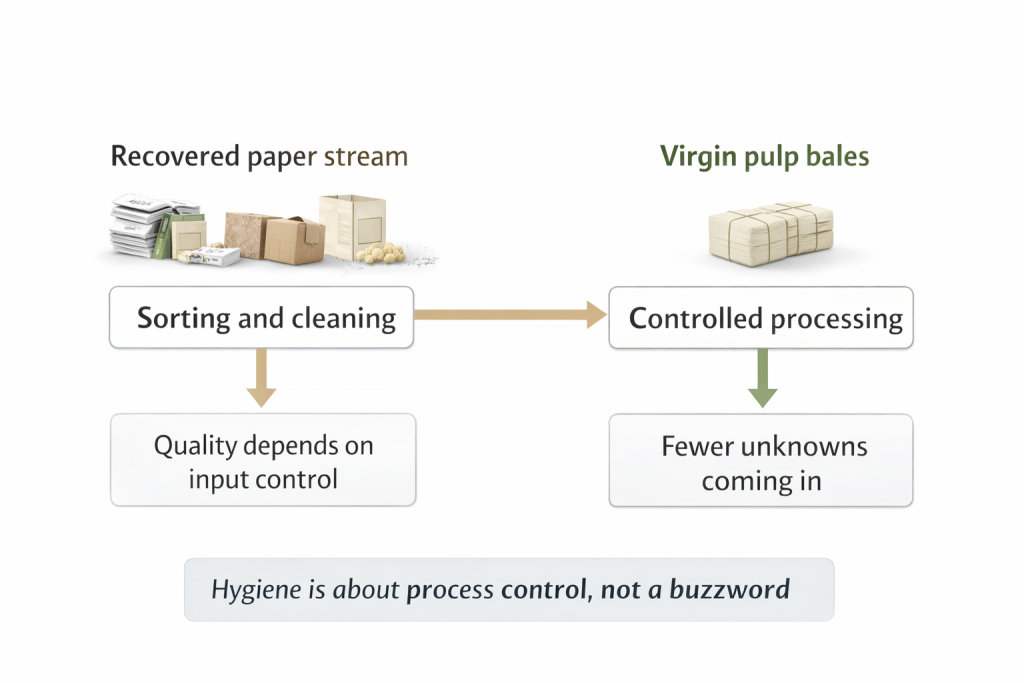
Virgin fiber production starts from a controlled raw material.
That usually makes hygiene control simpler, with fewer unknowns coming in.
If hygiene is your top priority
- choose reputable suppliers with strong process control
- look for clear statements of source and quality standards
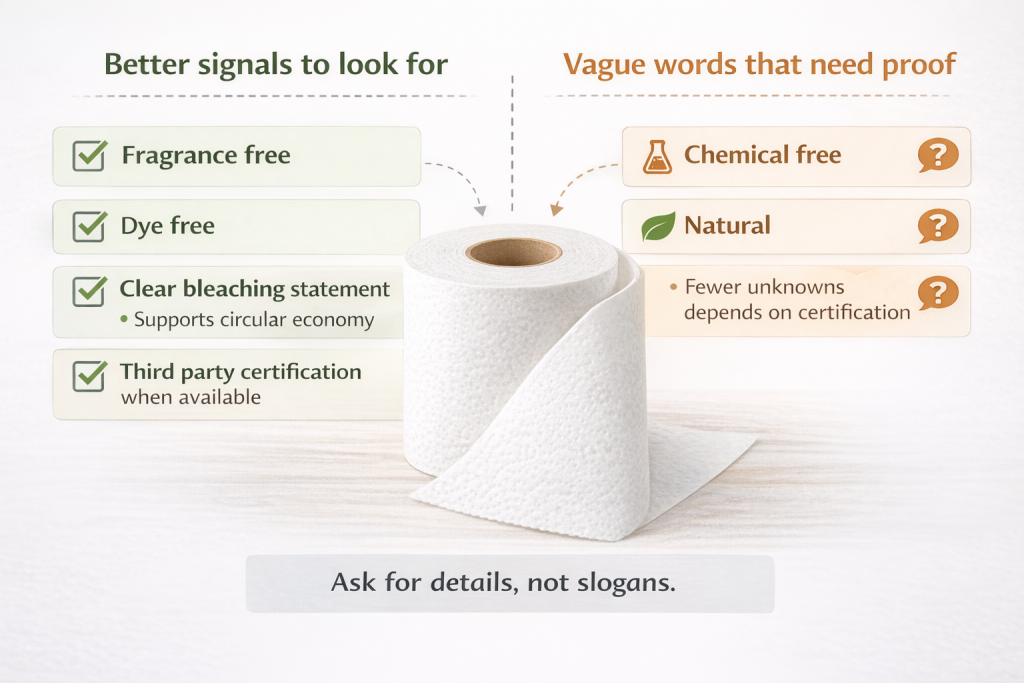
- avoid relying on vague buzzwords, like “green”, “natural”, “eco”
For sensitive households, the more useful signals are often simpler
- fragrance free
- dye free
- low lint
- clear, consistent quality over time
6、Sustainability, a comparison that stays honest
Many articles turn this into a moral fight.
It is more useful to see it as a tradeoff you can manage.
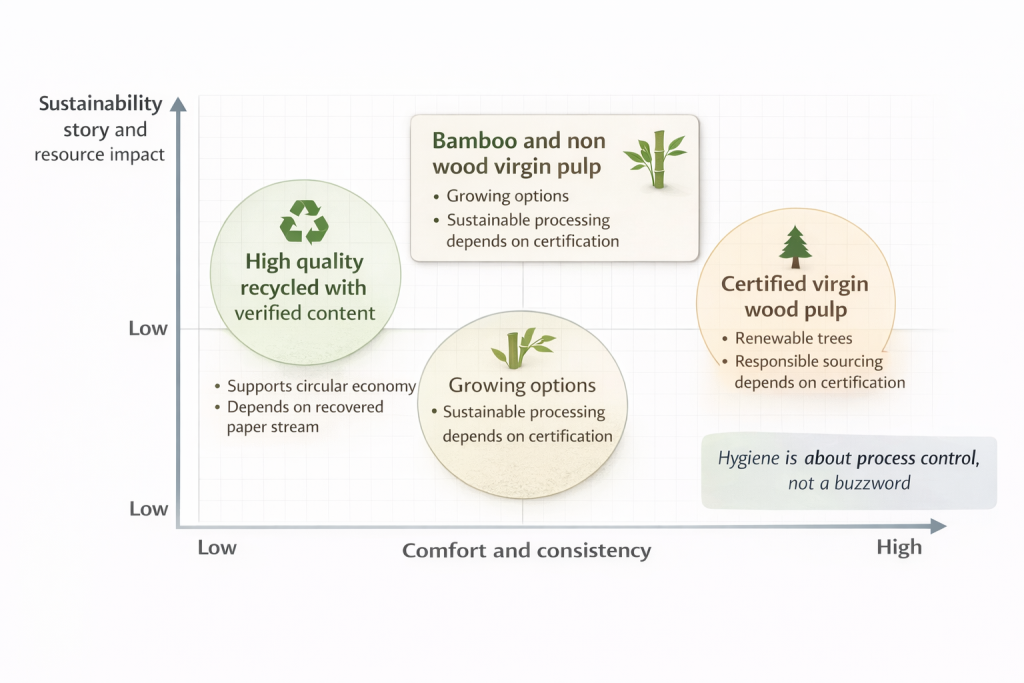
Recycled tissue can reduce demand for new fiber
Using recovered paper can reduce pressure on forests.
It can divert waste from landfill, and support circular supply chains.
It can also use less water and energy in many cases.
But the exact footprint depends on the mill, the energy mix, and the de-inking steps required.
Virgin tissue can be sustainable when sourcing is responsible
Trees are a renewable resource when forests are managed responsibly.
Certified sourcing helps address concerns about illegal logging and ecosystem damage.
If you buy virgin wood pulp tissue, look for evidence of responsible forestry
- FSC certification
- PEFC certification
- transparent sourcing and chain-of-custody practices
The overlooked sustainability factor, performance reduces waste
A sheet that works well can reduce overuse.
If guests use fewer sheets per visit, you reduce total consumption.
That can matter in high traffic restrooms.
Softness and strength are not just comfort, they can be part of waste reduction.
7、Bleaching and “chemical free” claims, what to watch
Many buyers want a clean, bright product.
Brightness often requires bleaching steps, regardless of fiber type.
Recycled tissue often uses oxygen-based systems like hydrogen peroxide.
Virgin tissue can use different sequences, and responsible mills manage emissions and byproducts.
The label “chemical free” is usually not a technical statement.
Papermaking is a process industry, and process aids exist even in “natural” positioning.
If you want a safer way to choose
- prioritize fragrance free and dye free first
- ask for basic compliance documents for contact safety and hygiene
- ask for a clear explanation of bleaching approach, not just a slogan
8、How to choose, a simple decision guide
You do not need to memorize pulp terminology.
You need a clear priority.
If you want the softest, most consistent feel
Start with virgin wood pulp options.
Then compare by structure, not just fiber claims.
Look at
- ply design
- embossing
- sheet basis weight
- lint level
- strength when wet
If you want the strongest sustainability narrative
Consider certified virgin, or high quality recycled with verified recycled content.
If you like bamboo, choose products that are transparent about processing and quality.
Look at
- FSC or PEFC for virgin wood pulp
- stated recycled percentage for recycled tissue
- supplier transparency on process control
- performance that reduces overuse
If you have sensitive skin at home
Avoid unnecessary irritants.
Do not assume “pure wood pulp” equals gentle.
A practical checklist
- fragrance free
- dye free
- low lint
- consistent quality, no rough batch-to-batch changes
- if irritation persists, switch and observe, not all products behave the same
If you manage a business restroom
Think cost per use, not cost per roll.
Consistency matters more than marketing claims.
Look at
- controlled roll size and sheet count
- stable strength to reduce double pulling
- dispersibility to reduce blockage risk
- reliable supply, consistent specification
9、What OEM and private label buyers should ask for
If you are sourcing from a factory, your job is to turn vague words into measurable specs.
That is how you prevent disputes and protect your brand.
Define the fiber claim in writing
Do not rely on a product name.
Write the meaning into the specification.
Examples of what to define
- virgin wood pulp, first use wood fiber, no post-consumer recycled content
- recycled content, specify post-consumer percentage, and accepted input grades
- pure wood pulp, wood-only fiber source, plus a statement of virgin or recycled status
Ask for a simple quality pack
The goal is not paperwork for its own sake.
The goal is consistency and risk control.
Request items like
- product specification sheet for basis weight, ply, sheet size, roll diameter, core size
- production and inspection records by batch
- hygiene and safety statements that match your target market requirements
- certification evidence when you claim FSC or PEFC
- packaging and labeling proof, especially for fiber claims
Verify the performance that customers actually feel
Your customers do not buy fiber terminology.
They buy softness, strength, and a clean experience.
Request evaluation samples and set acceptance criteria
- softness hand feel targets
- wet strength targets
- lint targets
- dispersibility expectations for your market
- roll consistency tolerances
At HengChang Paper, we see this as the difference between a good shipment and a stable long-term program.
Clear specs and steady process control save time for everyone.
Common myths, cleared up quickly
Myth 1, pure wood pulp always means virgin
It often does not.
You need confirmation of virgin or recycled status.
Myth 2, recycled is always the greener option
It can be, but it depends on the mill, energy mix, and the recovered paper stream.
Verified recycled content and strong process control matter.
Myth 3, virgin wood pulp is always bad for forests
It can be responsibly sourced when certification and transparency are real.
Look for credible certification, not just claims.
Myth 4, “natural color” tissue means no chemicals
Unbleached does not automatically mean low processing.
Some non wood fibers still need processing to meet softness and strength expectations.
FAQ
Is virgin wood pulp toilet paper always better
It is often more consistent in softness and strength.
Better for you depends on your priorities, especially sustainability and budget.
Does pure wood pulp mean chemical free
No, it usually does not.
If you want fewer irritants, prioritize fragrance free and dye free options.
Is recycled toilet paper safe
It can be safe when produced with strong hygiene control.
Quality varies more, choose reputable suppliers and consistent specifications.
Is bamboo toilet paper better than wood pulp
It can be a good option, especially when sourcing and processing are transparent.
Performance varies a lot, sample and compare before committing.
What is the easiest way to avoid being misled by labels
Ask one question.
Is the fiber virgin, recycled, or a stated blend with a clear percentage.
A simple takeaway
If you want stable softness and fewer surprises, virgin wood pulp is often the most straightforward choice.
If you want to reduce virgin fiber demand, recycled can be excellent when quality control is strong and recycled content is verified.
If you want to use “pure wood pulp” as a decision factor, treat it as a source hint, not a virgin guarantee.
“`