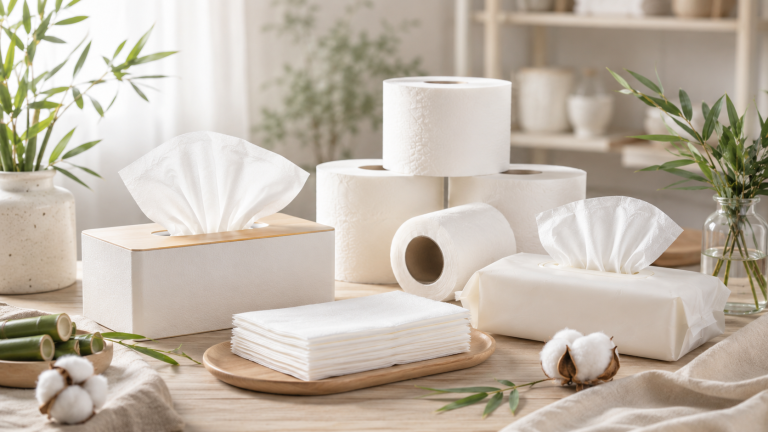
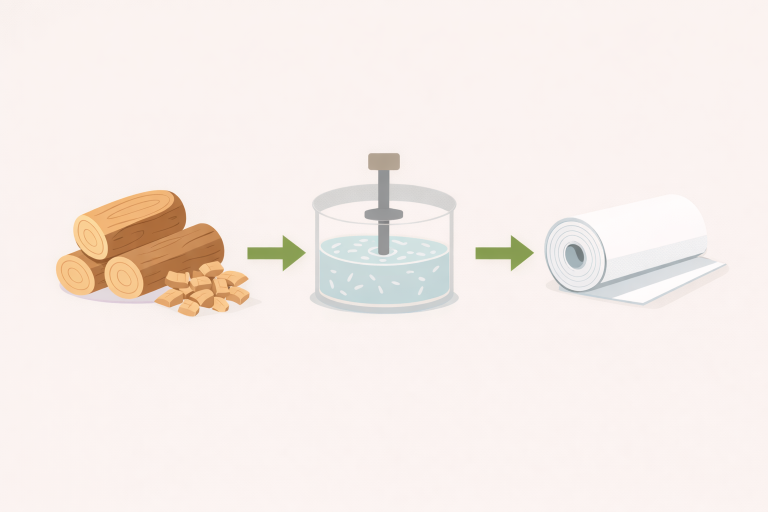
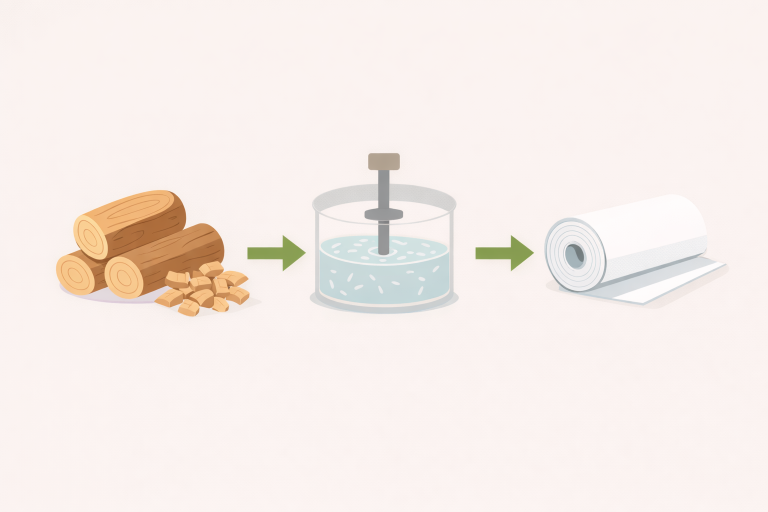
Tissue paper converting is the process of turning large parent rolls into finished tissue products.
These finished products include toilet paper rolls, kitchen paper towels, facial tissues, hand towels, napkins, and other daily-use paper products.
For consumers, converting affects softness, tearing, absorbency, roll size, sheet count, and packaging.
For brands and bulk buyers, it affects production efficiency, product consistency, private label design, and final market value.
This guide explains the tissue converting process in a practical way, from jumbo rolls to finished packs.
1、What Is Tissue Paper Converting
Tissue converting happens after the paper mill has already produced large tissue parent rolls.
A paper mill makes the base tissue sheet.
A converting line changes that base sheet into a product that people can actually use.
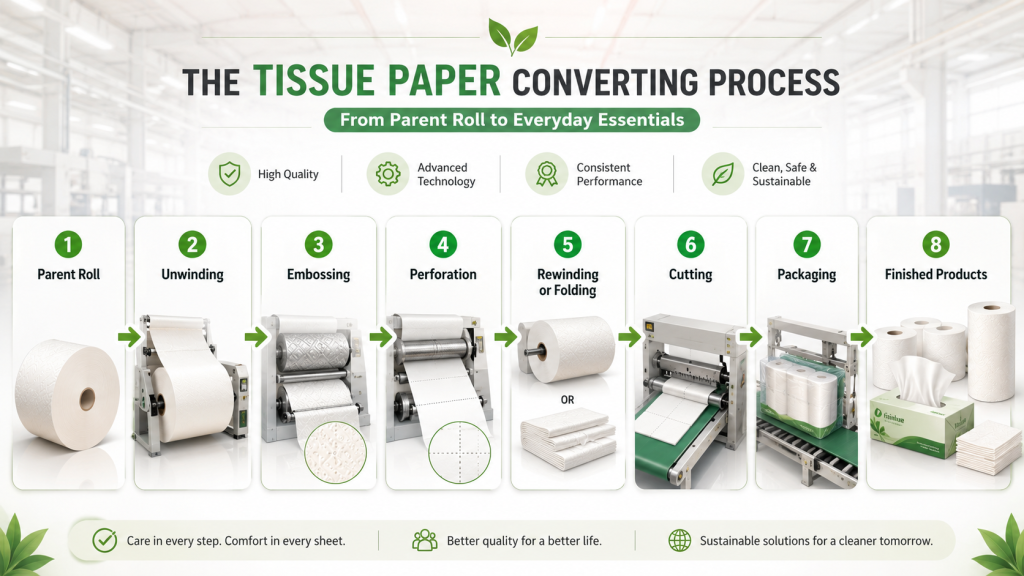
In simple terms, converting can include:
- Unwinding
- Embossing
- Lamination
- Perforation
- Rewinding
- Cutting
- Folding
- Packing
- Cartoning
- Palletizing
Different products need different converting steps.
Toilet paper needs rewinding, perforation, log cutting, and packing.
Facial tissue needs cutting, folding, counting, and box or soft-pack packaging.
Kitchen towels need stronger embossing, perforation, rewinding, cutting, and wrapping.
Napkins need embossing, cutting, folding, and packing.
That is why tissue converting is not just a simple cutting process.
It is the stage where raw tissue becomes a usable product.
2、Why Tissue Converting Matters
A tissue product may start from the same parent roll, but the final result can feel very different.
The converting process decides many details that users notice immediately.
For example:
- How soft the sheet feels
- How easily it tears along the perforation
- How neat the roll edge looks
- How stable the roll shape is
- How well plies stay together
- How clean the folding is
- How attractive the package looks
- How convenient the product is to use
A good converting process improves both function and appearance.
A poor converting process can create problems.
The tissue may tear badly, shed lint, look uneven, feel loose, or create complaints after sale.
For tissue paper OEM buyers, this step is especially important.
Good materials matter, but good converting turns those materials into a stable commercial product.
3、Main Tissue Products Made by Converting
Tissue converting lines can produce many types of finished paper products.

Each product has its own structure and production focus.
Toilet paper rolls
Toilet paper rolls are one of the most common converted tissue products.
The line usually rewinds tissue into long logs, adds perforation, cuts the logs into small rolls, and packs them.
Key points include:
- Roll diameter
- Core size
- Sheet size
- Ply count
- Perforation strength
- Softness
- Dissolvability
- Packing count
For household use, comfort and softness matter more.
For commercial use, roll length, cost per use, and packaging efficiency are often more important.
Kitchen paper towels
Kitchen towels need stronger wet performance than toilet paper.
They are used for cleaning, wiping spills, and absorbing water or oil.
The converting process often uses embossing and ply bonding to improve absorbency and strength.
Key points include:
- Wet strength
- Absorbency
- Sheet size
- Roll length
- Embossing pattern
- Perforation quality
- Packaging strength
A kitchen towel that looks thick but tears too easily may not satisfy users.
Facial tissues
Facial tissues focus on softness, cleanliness, and neat folding.
They can be packed in boxes, soft packs, pocket packs, or hanging packs.
Key points include:
- Sheet softness
- Low lint
- Sheet count
- Folding accuracy
- Pull-out smoothness
- Box or pack design
- Fragrance-free or lotion options
For private label facial tissue, packaging design often plays a large role in shelf appeal.
Hand towels and napkins
Hand towels and napkins are often used in restaurants, offices, hotels, and public washrooms.
They may be folded into different formats depending on the dispenser or usage scene.
Common options include:
- C-fold
- V-fold
- Z-fold
- Interfold
- Dinner napkins
- Cocktail napkins
For these products, folding accuracy and sheet count control are very important.
A small folding error can affect dispensing, packing, and user experience.
4、Step-by-Step Tissue Converting Process
Although each converting line is different, most tissue products follow several core steps.
Unwinding the parent roll
The process starts with a large tissue parent roll.
This roll is loaded onto the machine and unwound under controlled tension.
Stable tension is very important.
If the tension is too high, the tissue may stretch or break.
If the tension is too low, the web may wrinkle, shift, or run unevenly.
A good unwinding system keeps the tissue sheet moving smoothly into the next process.
Web control and tension control
Tissue paper is thin and delicate.
During converting, the web needs to stay flat, centered, and stable.
Machines may use sensors, rollers, brakes, and tension control systems to guide the paper.
This step helps reduce:
- Wrinkles
- Edge drifting
- Sheet breaks
- Uneven winding
- Poor cutting accuracy
For high-speed production, web control can directly decide the defect rate.
Embossing
Embossing presses patterns into the tissue sheet.
The pattern may be dots, waves, flowers, logos, or simple texture.
Embossing can improve appearance and increase bulk.
It can also help create a softer feeling by changing the surface texture.
For some products, embossing also improves absorbency.
However, too much pressure may reduce strength.
This is why embossing needs balance.
The pattern should look good, feel comfortable, and keep the sheet strong enough for use.

Lamination and ply bonding
Many tissue products use two or more plies.
Lamination or ply bonding keeps these layers together.
This can be done with glue, mechanical pressure, embossing, or other bonding methods.
Good ply bonding helps the tissue feel thicker and more stable.
Poor bonding may cause layers to separate during use.
For premium tissue, lamination affects both hand feel and user perception.
For OEM production, the bonding method should match the product purpose and price level.
Perforation
Perforation creates small tear lines.
This is common for toilet paper and kitchen paper towels.
Good perforation lets users tear off one sheet easily.
If the perforation is too weak, sheets may break during rewinding or packing.
If it is too strong, users may need to pull too hard.
That can damage the roll shape or create frustration.
Good perforation feels simple, clean, and natural during use.
Rewinding
For roll products, the tissue sheet is rewound into smaller logs.
These logs are later cut into final rolls.
Rewinding controls roll tightness, diameter, and shape.
A roll that is too loose may look large but contain less paper.
A roll that is too tight may feel hard and less comfortable.
Stable rewinding helps make each roll consistent.
This matters for packaging, palletizing, and customer trust.
Cutting or log sawing
After rewinding, tissue logs are cut into smaller rolls.
For folded tissue products, the sheet is cut into specific sheet sizes.
Cutting accuracy affects the final appearance.
Clean cuts make the product look more professional.
Poor cutting can create rough edges, dust, or uneven roll width.
For retail products, edge quality is part of the first impression.
Folding and counting
Facial tissues, hand towels, and napkins need folding.
The machine cuts and folds the tissue into the required format.
Accurate counting is also important.
If the pack says 100 sheets, the customer expects 100 sheets.
Folding also affects how smoothly the tissue pulls out from a box or dispenser.
For interfold products, one sheet should pull the next sheet into place.
This small detail has a big effect on user convenience.
Packaging
Packaging protects the finished tissue product from dust, moisture, and damage.
It also carries the brand image.
Common packaging types include:
- Plastic wrapping
- Paper wrapping
- Cartons
- Soft packs
- Boxes
- Bulk bags
- Private label printed packaging
For OEM buyers, packaging is not only protection.
It is also part of the product strategy.
A good package should fit shelf display, transport, storage, and customer expectations.
Palletizing and shipment
After packaging, products are packed into cartons and stacked on pallets.
Palletizing helps protect the product during warehouse storage and transportation.
Important details include:
- Carton strength
- Pallet size
- Stack height
- Moisture protection
- Batch code
- Shipping mark
- Loading method
For export orders, pallet and carton design can reduce damage and improve loading efficiency.
5、Main Tissue Converting Machines
Tissue converting machines vary depending on the product type.
A factory may use different lines for toilet paper, kitchen towels, facial tissues, and napkins.
Toilet paper converting line
A toilet paper converting line usually includes:
- Parent roll unwinding
- Embossing
- Perforation
- Rewinding
- Tail sealing
- Log cutting
- Roll packing
- Cartoning
This line is designed for roll products.
It can produce household rolls, commercial rolls, jumbo rolls, mini jumbo rolls, or coreless rolls.
Kitchen towel converting line
Kitchen towel converting is similar to toilet paper converting, but the product usually needs more strength and absorbency.
The line may use stronger embossing and better ply bonding.
Key machine concerns include wet strength, sheet size, roll diameter, and perforation control.
Facial tissue converting line
A facial tissue converting line usually includes:
- Unwinding
- Slitting
- Cutting
- Folding
- Counting
- Soft pack or box packing
The focus is folding accuracy and smooth dispensing.
For boxed facial tissue, the tissue must pull out easily without tearing or bringing too many sheets at once.
Napkin converting machine
Napkin converting machines cut, emboss, fold, and pack tissue sheets.
They can produce different napkin sizes and fold styles.
Some lines also support printing.
This is useful for restaurants, events, airlines, hotels, and private label napkin projects.
Hand towel converting line
Hand towel lines produce folded towels for public washrooms, offices, hospitality, and commercial spaces.
The most important points are folding format, absorbency, sheet strength, and dispenser compatibility.
6、Quality Factors That Decide the Final Product
Tissue converting quality depends on more than machine speed.
Many small details decide whether the final product feels premium or cheap.
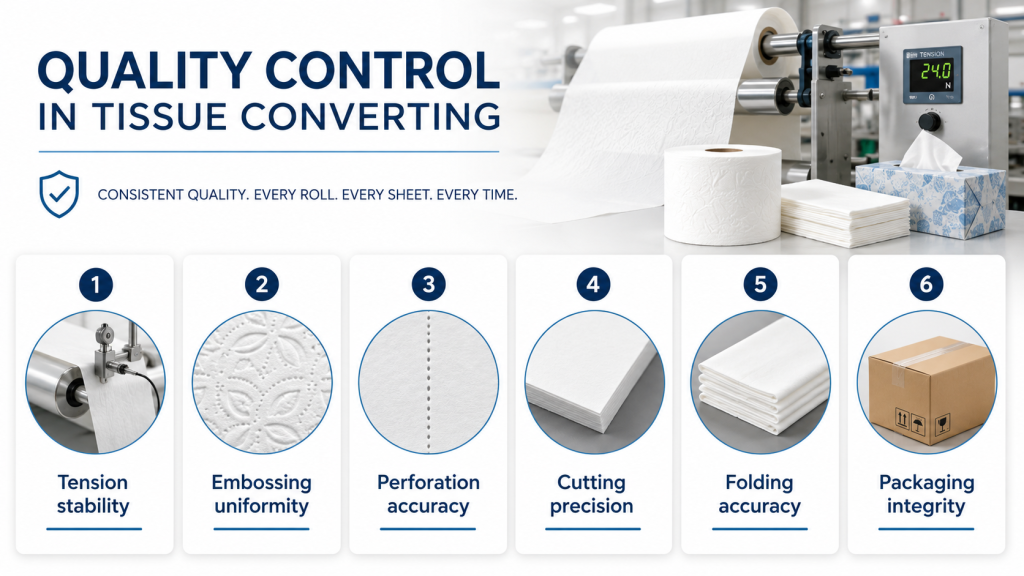
Tension stability
Tension control is one of the most important parts of converting.
Stable tension keeps the paper web flat and controlled.
It helps reduce tearing, wrinkling, and uneven winding.
Embossing uniformity
Embossing should look consistent across the sheet.
Uneven embossing may create weak spots, poor appearance, or different hand feel.
For premium products, embossing is also part of the brand identity.
Perforation accuracy
Good perforation creates a clean tear.
This is especially important for toilet paper and kitchen towels.
The tear line should be easy to use but strong enough during production.
Cutting precision
Cutting affects roll width, sheet size, and edge neatness.
Clean cutting also reduces dust and improves package appearance.
Folding accuracy
For facial tissues, napkins, and hand towels, folding accuracy affects dispensing and packing.
Poor folding can cause jammed packs, messy boxes, or uneven stack height.
Packaging integrity
Good packaging protects tissue from moisture, dust, compression, and transport damage.
It also helps products look clean and trustworthy.
For export and wholesale, packaging quality is just as important as the tissue itself.
7、Common Problems in Tissue Converting
Even with good raw materials, converting problems can still happen.
Here are some common issues.
Web break
The tissue sheet breaks during production.
Possible causes include unstable tension, weak parent roll quality, wrong machine settings, or sharp tension changes.
Wrinkles
Wrinkles may come from poor web guiding, uneven tension, or roller problems.
Wrinkled tissue can affect cutting, folding, and appearance.
Poor perforation
If perforation is too weak, sheets may break too early.
If it is too strong, users cannot tear easily.
Both problems reduce user satisfaction.
Loose or uneven rolls
Poor rewinding can create rolls that look uneven, too soft, or unstable.
This can also affect packaging efficiency.
Ply separation
If lamination or emboss bonding is poor, tissue layers may separate.
This makes the product feel lower quality.
Packaging defects
Packaging defects may include open seals, wrong count, poor printing, loose wrapping, or carton damage.
For private label products, packaging defects can damage brand trust quickly.
8、How Tissue Converting Supports OEM and Private Label
For tissue paper OEM buyers, converting is where customization becomes real.
The same base tissue can be converted into different products depending on market needs.
OEM buyers can customize:
- Product type
- Ply count
- GSM
- Sheet size
- Roll length
- Roll diameter
- Core size
- Embossing pattern
- Perforation distance
- Folding style
- Sheet count
- Package design
- Carton specification
- Private label branding
This flexibility is useful for supermarkets, distributors, hotels, cleaning suppliers, and household paper brands.
At HengChang Paper, toilet paper OEM and tissue paper OEM projects are usually planned around the buyer’s target market.
That means the discussion is not only about price.
It also includes usage scene, packaging style, shipping needs, and customer expectations.
This approach helps create tissue products that are easier to sell and more stable in daily use.
9、Cost, Efficiency, and Sustainability in Tissue Converting
Tissue converting cost is affected by many factors.
Common cost drivers include:
- Raw material quality
- Ply count
- GSM
- Product size
- Machine speed
- Labor
- Energy use
- Packaging material
- Waste rate
- Order quantity
- Custom printing
- Carton and pallet requirements
A faster machine does not always mean lower cost.
If the machine runs fast but creates many defects, the real cost may become higher.
A stable converting process can reduce waste, improve output, and make product quality more consistent.
For OEM buyers, it is better to compare total value, not only unit price.
A slightly higher-cost product may perform better, receive fewer complaints, and support a stronger brand image.
Sustainability in Tissue Converting
Sustainability is becoming more important in the tissue paper industry.
Converting can support sustainability in several ways.
- Reduce trim waste
- Improve production efficiency
- Use recyclable packaging where suitable
- Optimize roll length and sheet count
- Reduce over-packaging
- Improve carton loading efficiency
- Support certified or recycled raw materials
- Reduce rejected products through better quality control
Eco-friendly tissue is not only about the fiber.
It also depends on how the product is converted, packed, stored, and shipped.
For consumers, sustainable products should still be comfortable and reliable.
For buyers, sustainability should be practical, traceable, and suitable for the market.
10、Checklist for Choosing a Tissue Converting Supplier
Before placing a tissue paper OEM order, buyers should ask clear questions.
Product specification
- What tissue product do you need
- What ply count is required
- What GSM is suitable
- What sheet size or roll size do you need
- What is the target roll diameter or pack size
- What is the expected sheet count
Material and performance
- What raw material is used
- Is it virgin pulp, bamboo pulp, recycled pulp, or blended pulp
- What softness level is needed
- What absorbency is needed
- Does the product need wet strength
- Does toilet paper need fast dissolving performance
Converting details
- What embossing pattern is available
- What perforation length is required
- What folding style is needed
- What core size is used
- How is roll tightness controlled
- How is sheet count checked
Packaging and branding
- Do you need private label packaging
- What bag, box, or carton style is required
- Do you need barcode or batch code
- What language should appear on the package
- What pallet method is suitable for shipping
Quality control
- How does the supplier check dimensions
- How does the supplier control weight and count
- How does the supplier inspect packaging
- Can samples be confirmed before mass production
- Can batch records be provided
A good supplier should help buyers connect product design with real production.
This makes the order smoother and reduces misunderstanding.
11、Final Thoughts
Tissue paper converting is the key process that turns large parent rolls into daily products people use at home, in hotels, in offices, and in public spaces.
It includes many steps, such as unwinding, embossing, lamination, perforation, rewinding, cutting, folding, packaging, and palletizing.
Each step affects the final product.
Softness, absorbency, tear quality, roll shape, folding accuracy, packaging appearance, and product stability all depend on good converting control.
For consumers, good converting means a better daily experience.
For OEM buyers, good converting means stable quality, flexible customization, fewer complaints, and stronger brand value.
HengChang Paper supports toilet paper OEM and tissue paper OEM projects with attention to material choice, converting details, packaging, and practical market needs.
A well-converted tissue product does more than look good on the shelf.
It works well in real life.