contents
- 1、Why Tissue Paper Material Matters
- 2、Common Types of Tissue Paper Materials
- 3、Virgin Pulp vs Recycled Fiber
- 4、How to Judge Tissue Paper Quality
- 5、Safety, Whiteness, Scent, and Printing
- 6、Shelf Life, Storage, and Daily Use Tips
- 7、Sustainability and Eco-Friendly Material Choices
- 8、A Practical Checklist for Tissue Paper OEM Buyers
- 9、Final Thoughts
- 10、FAQ
Choosing good tissue paper is not only about softness.
The right material affects comfort, hygiene, absorbency, strength, shelf life, and even how environmentally friendly the product feels to users.
For families, it means safer and more comfortable daily use.
For brands, hotels, retailers, and private label buyers, it also affects customer satisfaction, repeat purchase, and product positioning.
Below is a practical guide to help you understand tissue paper materials and choose better products with more confidence.
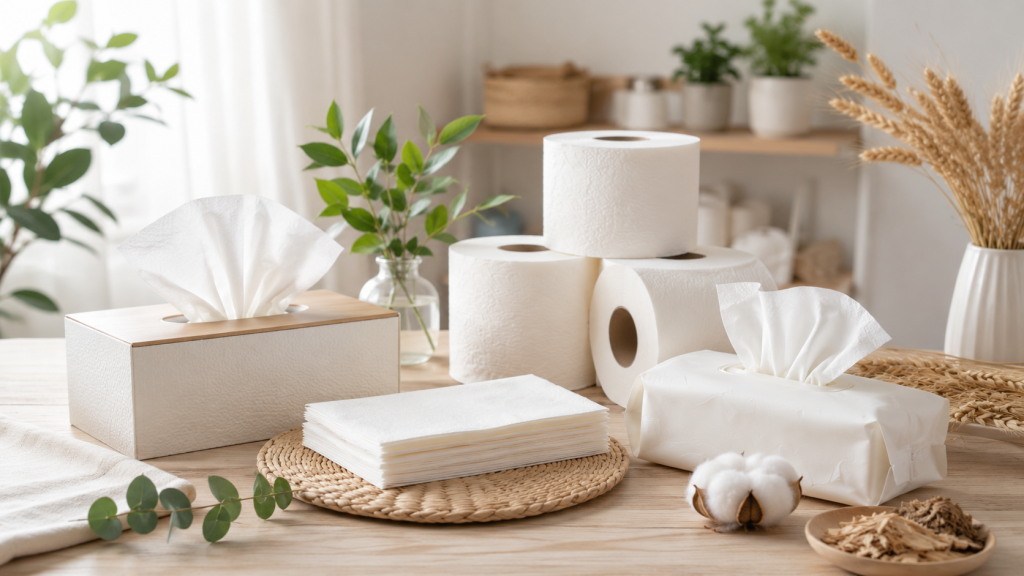
1、Why Tissue Paper Material Matters
Tissue paper looks simple, but the material behind it decides how it performs.
A good tissue should feel soft on the skin, absorb moisture well, stay clean and safe, and not shed too much lint during use.
Poor material can cause several problems.
- Rough hand feel
- Easy tearing
- Powder or lint shedding
- Weak absorbency
- Unstable quality between batches
- Unclear hygiene and safety standards
For daily users, these problems affect comfort.
For bulk buyers and tissue paper OEM projects, these problems may affect reviews, complaints, and brand trust.
2、Common Types of Tissue Paper Materials
Most tissue paper is made from plant-based cellulose fibers.
The most common material choices include virgin wood pulp, pure wood pulp, recycled pulp, bamboo pulp, and blended fiber.
Each material has its own advantages.
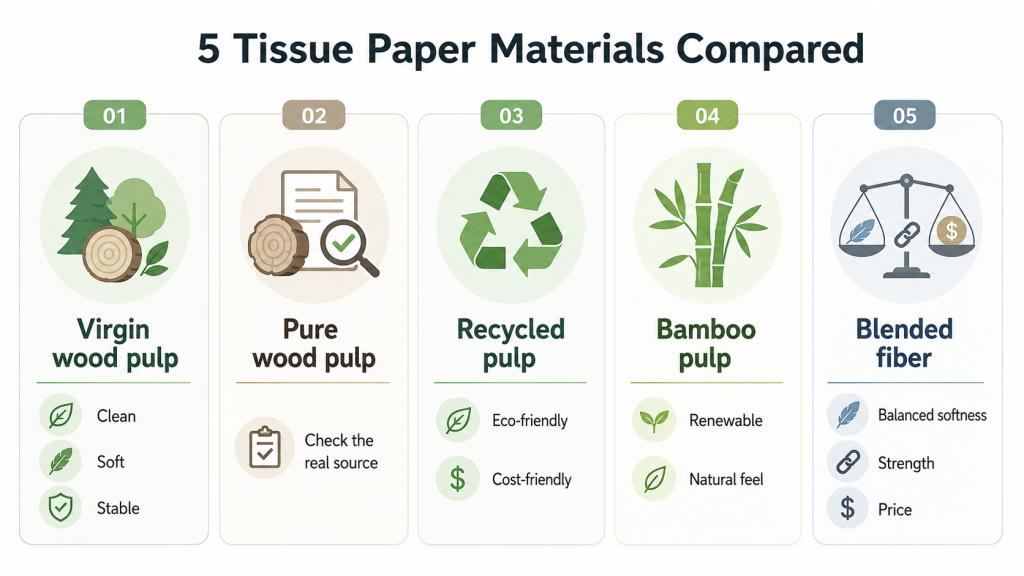
Virgin wood pulp
Virgin wood pulp is made from new wood fiber.
It is usually clean, stable, soft, and strong.
This material is often used for higher-quality facial tissues, toilet paper, napkins, and premium tissue products.
Virgin hardwood pulp often improves softness.
Virgin softwood pulp often improves strength.
A balanced blend can make tissue paper soft enough for the skin while still strong enough for daily use.
Pure wood pulp
Pure wood pulp sounds similar to virgin wood pulp, but buyers should check the real meaning carefully.
In some markets, pure wood pulp may include processed wood-based fiber, and the quality can vary depending on the source.
That is why product labels, supplier documents, and testing reports are important.
Do not judge only by the words on the package.
Recycled pulp
Recycled pulp is made from recovered paper materials.
It can reduce waste and lower the use of new wood resources.
However, recycled pulp usually needs careful cleaning, deinking, and quality control.
If the recycled fiber source is not stable, the tissue may feel rougher, look less clean, or have weaker strength.
Recycled tissue can be a good choice for eco-conscious markets, but buyers should check hygiene standards, brightness control, and supplier transparency.
Bamboo pulp
Bamboo pulp is becoming more popular because bamboo grows quickly and can be a renewable fiber source.
Good bamboo tissue can feel soft, smooth, and strong.
It is also attractive for brands that want a more natural or eco-friendly product image.
However, bamboo tissue quality still depends on the pulping process, bleaching method, and factory control.
Bamboo alone does not automatically mean premium quality.
Blended fiber
Many tissue products use a blend of different fibers.
This is common because one material rarely solves every need.
For example, a tissue product may use hardwood pulp for softness and softwood pulp for strength.
A commercial product may include recycled fiber to control cost and support sustainability.
For OEM buyers, blended fiber can be useful because it allows more flexible control over price, texture, strength, and market positioning.
3、Virgin Pulp vs Recycled Fiber
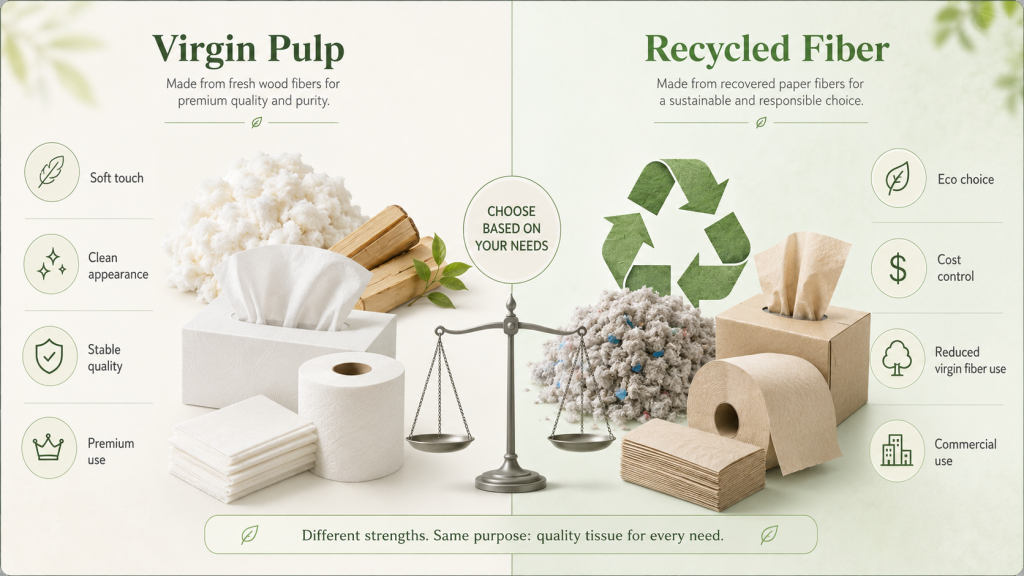
Many buyers ask whether virgin pulp is better than recycled fiber.
The answer depends on the product purpose.
Virgin pulp is usually better for products that need a clean appearance, soft touch, and stable performance.
It is often suitable for facial tissues, premium toilet paper, and products for sensitive skin.
Recycled fiber is often chosen for value lines, commercial use, or eco-positioned products.
It can be a smart option when the supply chain is reliable and the production process is well controlled.
Here is a simple way to compare them.
Choose virgin pulp when you care more about
- Softness
- Clean appearance
- Stable quality
- Premium positioning
- Lower lint shedding
- Skin comfort
Choose recycled fiber when you care more about
- Sustainability message
- Cost control
- Reduced virgin fiber use
- Commercial or public-use products
- Eco-friendly product lines
For private label brands, the best choice is often not one fixed answer.
It is better to define the target user first, then match the material to the market.
4、How to Judge Tissue Paper Quality
Softness is one of the first things consumers notice.
Facial tissue, pocket tissue, and toilet paper should feel gentle, especially for people who use them often.
Softness is affected by several factors.
- Fiber type
- Fiber length
- Pulp refining
- Ply count
- Embossing
- Softening treatment
- Moisture control
However, tissue that is too soft may become weak.
It may tear easily, leave lint, or fail during use.
A good tissue paper material should create balance.
Soft enough for comfort.
Strong enough for real use.
This balance is especially important for tissue paper OEM buyers, because a product that feels good in a sample must also perform well in mass production.
Strength and Absorbency Should Match the Use
Different tissue products need different performance.
Facial tissue should be soft and clean.
Toilet paper should be soft and easy to dissolve.
Paper towels should be absorbent and strong when wet.
Napkins should have enough strength for meals and light cleaning.
This is why one material cannot fit every tissue product.
Facial tissue
Facial tissue should focus on skin comfort, low lint, and clean touch.
Virgin wood pulp, bamboo pulp, or a soft blended pulp can work well.
Fragrance-free and dye-free options are better for sensitive users.
Toilet paper
Toilet paper should balance softness, strength, and water dispersibility.
It should not be too hard, but it should also not fall apart too quickly during use.
Most importantly, it should break down properly after flushing.
Facial tissue should not replace toilet paper because it is usually not designed to dissolve in the same way.
Paper towels
Paper towels need wet strength and absorbency.
Softness matters less than durability.
The material and structure should help the sheet absorb water, oil, or spills without tearing too quickly.
Napkins
Napkins need a balance of appearance, thickness, softness, and strength.
For restaurants, events, and private label packaging, color, embossing, and folding style also matter.
5、Safety, Whiteness, Scent, and Printing
Many people think whiter tissue paper means cleaner tissue paper.
This is not always true.
Normal tissue paper can be ivory white, natural white, or light cream depending on the fiber and process.
Extremely white tissue may come from stronger bleaching or optical brightening.
For daily use, especially for facial tissue and toilet paper, buyers should pay more attention to safety, certification, and supplier control.
A natural clean color is often more trustworthy than an overly bright white appearance.
When buying tissue products, check whether the product is free from unnecessary dyes, strong fragrance, and harmful chemical residues.
Are Scented and Printed Tissues Safe
Scented and printed tissues can look attractive.
They are common in napkins, decorative tissues, gift packaging, and event products.
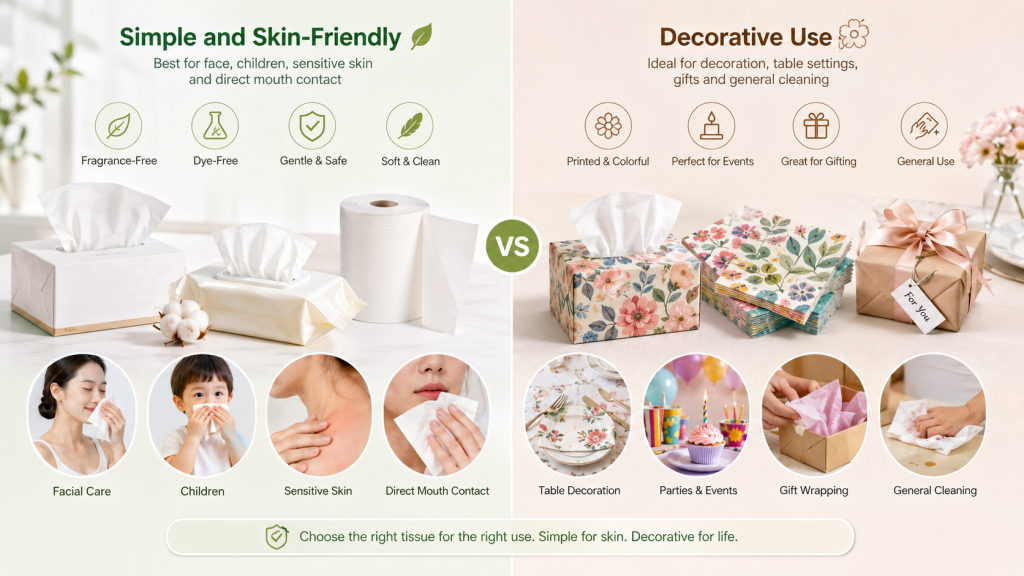
However, for tissues used on the face, mouth, or sensitive skin, simple is often better.
Fragrance, dye, and ink may increase the chance of irritation for some users.
This does not mean all printed or scented tissue is unsafe.
It means the use case matters.
Use decorative or scented tissue for hands, tables, events, or packaging.
Use fragrance-free and dye-free tissue for facial care, children, sensitive skin, and direct mouth contact.
How to Check Tissue Paper Quality at Home
You do not need a laboratory to make a basic judgment.
These simple checks can help consumers compare tissue quality.
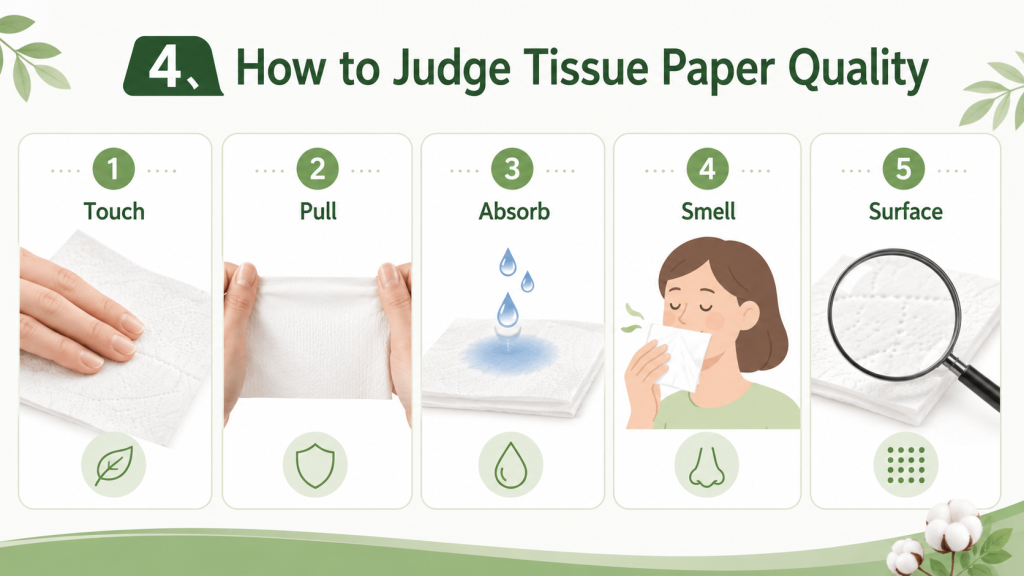
Touch the tissue
Good tissue usually feels smooth, soft, and even.
Poor tissue may feel rough, loose, or dusty.
If it sheds too much powder or lint, the fiber quality or bonding may not be good.
Pull it gently
A good tissue should have reasonable toughness.
It should not break immediately with light pulling.
If it tears too easily, the fiber strength may be low.
Check absorbency
Put a few drops of water on the tissue.
Good tissue should absorb water evenly.
For paper towels, the sheet should stay relatively strong when wet.
For toilet paper, it should break down more easily in water than facial tissue or napkins.
Smell it
A clean tissue should not have a strong chemical smell.
A strong fragrance may cover raw material odor, but it may not be suitable for sensitive users.
Look at the surface
The surface should be even.
Too many dark spots, dust, or uneven fibers may show unstable raw material control.
6、Shelf Life, Storage, and Daily Use Tips
Tissue paper usually has a shelf life of around two to three years when stored properly.
After opening, it is better to use it within a reasonable time because the product is exposed to air, dust, and moisture.
Storage conditions are important.
- Keep tissue paper in a dry place
- Avoid direct sunlight
- Keep it away from strong odors
- Do not store it directly on the floor
- Protect bulk cartons from moisture
- Use older stock first
For households, this helps keep tissue clean.
For bulk buyers, good storage helps protect product quality before resale or distribution.
7、Sustainability and Eco-Friendly Material Choices
In 2026, many customers care about more than softness and price.
They also want to know where the material comes from and whether the product is responsibly made.
Common sustainability choices include recycled fiber, bamboo pulp, certified wood pulp, plastic-reduced packaging, and lower-impact production.
Useful certifications may include FSC, PEFC, compostable labels, or other local eco-labels depending on the market.
For buyers, certifications are helpful because they reduce uncertainty.
They show that the supplier has at least some level of traceability and responsible sourcing.
The uploaded sourcing guide also highlights that raw material choice affects softness, strength, environmental footprint, compliance, and long-term supply stability.
8、A Practical Checklist for Tissue Paper OEM Buyers
For tissue paper OEM projects, material selection should be more specific than “soft” or “good quality.”
Buyers should ask clear questions before confirming production.
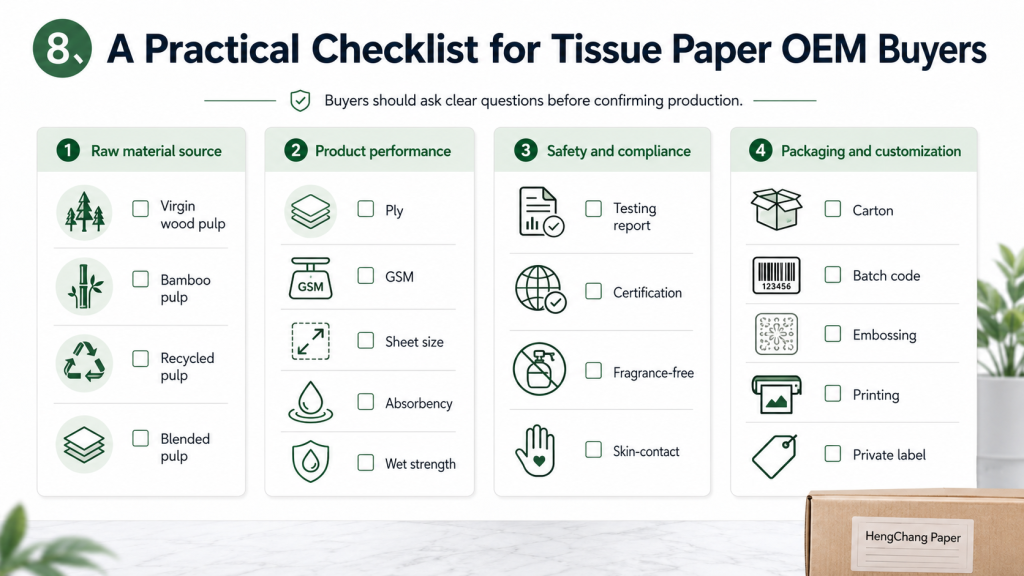
Ask about raw material source
- Is it virgin wood pulp, bamboo pulp, recycled pulp, or blended pulp
- Is the fiber source stable
- Can the supplier provide material documents
- Are certifications available
Ask about product performance
- Ply count
- GSM
- Sheet size
- Roll length
- Absorbency
- Wet strength
- Lint control
- Dissolvability for toilet paper
Ask about safety and compliance
- Is the tissue fragrance-free or dyed
- Are food-contact or skin-contact standards considered
- Are testing reports available
- Are there limits for fluorescent agents or harmful residues
Ask about packaging and storage
- Inner packing material
- Carton strength
- Batch code
- Shelf life
- Pallet packing
- Moisture protection
Ask about customization
- Embossing
- Printing
- Sheet size
- Ply
- Roll diameter
- Core size
- Packaging design
- Private label options
At HengChang Paper, we work with toilet paper OEM and tissue paper OEM projects, so material choice is usually discussed together with product use, target price, packaging, and market positioning.
This helps avoid choosing a material that looks good on paper but does not fit the real customer.
How to Choose the Best Tissue Paper Material
There is no single best material for every tissue product.
The best choice depends on the user, usage scene, budget, and brand goal.
For sensitive skin
Choose soft, fragrance-free, dye-free tissue.
Virgin pulp or high-quality bamboo pulp is usually a better fit.
For daily household use
Choose a balanced material with good softness, strength, and value.
A stable virgin pulp blend or bamboo blend can work well.
For eco-conscious buyers
Choose certified recycled fiber, bamboo pulp, or responsibly sourced virgin pulp.
Also check packaging and supplier transparency.
For hotels and restaurants
Choose stable quality, good appearance, and reliable supply.
Napkins, facial tissues, and toilet paper may need different material blends.
For private label brands
Start with the market position.
Premium, eco-friendly, value, family use, hotel use, and commercial use all need different specifications.
Then choose the material and product structure around that position.
9、Final Thoughts
Good tissue paper starts with good material.
Virgin wood pulp can bring softness and stability.
Recycled fiber can support sustainability and cost control.
Bamboo pulp can offer a natural and renewable product story.
Blended fiber can help balance comfort, strength, price, and market needs.
For consumers, the best tissue is safe, soft, clean, and suitable for the right use.
For OEM buyers, the best tissue is also stable in production, clear in sourcing, and easy to position in the market.
HengChang Paper pays close attention to these details when supporting toilet paper OEM and tissue paper OEM projects, because a better material choice leads to a better product experience.
10、FAQ
1、What is the best material for tissue paper
Virgin wood pulp is often preferred for softness, cleanliness, and stable quality.
Bamboo pulp and high-quality blended pulp are also good options depending on the product goal.
2、Is bamboo tissue paper better than wood pulp tissue
Bamboo tissue can be soft, strong, and renewable.
However, quality depends on the production process, not only the fiber type.
3、Is recycled tissue paper safe
Recycled tissue can be safe when the raw material source, deinking, cleaning, and hygiene control are well managed.
Buyers should check certifications and supplier testing.
4、Why should facial tissue and toilet paper not be mixed
Facial tissue is designed for softness and skin contact.
Toilet paper is designed to break down in water.
Using facial tissue as toilet paper may increase the risk of clogging.
5、Is whiter tissue paper always better
No.
Very white tissue paper does not always mean better quality.
Natural white or ivory white tissue can be safe and high quality when the material and production process are well controlled.
6、What should private label buyers check first
Private label buyers should first confirm the product use, target market, material type, ply, GSM, sheet size, packaging, safety standards, and supplier quality control process.